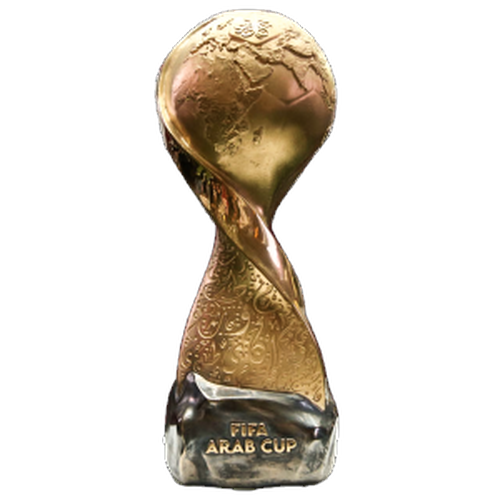
FIFA Arab Cup
Results
| Date | R | Home vs Away | - |
|---|---|---|---|
| 12/18 16:00 | 1 |
 Jordan vs Morocco

|
2-2 |
| 12/18 11:00 | 50 |
 [2] Saudi Arabia vs United Arab Emirates
[2]
[2] Saudi Arabia vs United Arab Emirates
[2] 
|
0-0 |
| 12/15 17:30 | 2 |
[2] Saudi Arabia vs Jordan
[1]
|
0-1 |
| 12/15 14:30 | 2 |
[1] Morocco vs Florian Jakob
[2] |
3-0 |
| 12/12 17:30 | 3 |
 [1] Algeria vs United Arab Emirates
[2]
[1] Algeria vs United Arab Emirates
[2]
|
1-1 |
| 12/12 14:30 | 3 |
[1] Jordan vs Iraq
[2] 
|
1-0 |
| 12/11 17:30 | 3 |
 [1] Palestine vs Saudi Arabia
[2]
[1] Palestine vs Saudi Arabia
[2]
|
1-1 |
| 12/11 14:30 | 3 |
[1] Morocco vs Syria
[2] 
|
1-0 |
| 12/09 17:00 | 3 |
 [4] Bahrain vs Sudan
[3]
[4] Bahrain vs Sudan
[3] 
|
3-1 |
| 12/09 17:00 | 3 |
[2] Algeria vs Iraq
[1]
|
2-0 |
| 12/09 14:30 | 3 |
[3] United Arab Emirates vs Kuwait
[4] 
|
3-1 |
| 12/09 14:30 | 3 |
 [2] Egypt vs Jordan
[1]
[2] Egypt vs Jordan
[1]
|
0-3 |
 Qatar
Qatar
 Tunisia
 Oman
Oman
 Lebanon
 Mauritania
 Comoros
Wikipedia - FIFA Arab Cup
The FIFA Arab Cup (Arabic: كأس العرب, romanized: Kaʾs al-ʿArab), often called the Arab Cup, is an international association football competition organized by FIFA. It is held every four years with the participation of senior men's national teams of the Union of Arab Football Associations (UAFA), the governing body for countries in the Arab world. The current champion is Morocco who won their second title at the 2025 tournament in Qatar.
The championship's inaugural edition, held in Lebanon in 1963, was won by Tunisia. After having been played in 1964 and 1966, the Arab Cup was halted for almost 20 years, before being contested in 1985. The tournament was played five more times until 2012, the last competition organized by the UAFA. The 2021 edition was the first organized by FIFA.
The eleven Arab Cup tournaments have been won by six national teams. Iraq have won four times; the other Arab Cup winners are Saudi Arabia and Morocco, with two titles each; and Algeria, Egypt, and inaugural winner Tunisia, with one title each.
Seven countries have hosted the Arab Cup. Qatar has been the host three times, while Kuwait and Saudi Arabia have each hosted twice; Lebanon, Iraq, Jordan and Syria have each hosted once. All Arab Cups have been held in Asia.
History
The initial idea to establish an Arab Cup came in 1957 from Lebanese journalist Nassif Majdalani and the Secretary General of the Lebanese Football Association (LFA) Izzat Al Turk. In 1962, the LFA called for the formal establishment of the tournament through their president Georges Dabbas, who organised a general Arab assembly for the formation of the Arab Cup. The first Arab Cup was held in Beirut in April and May 1963, with the participation of five teams.
During the 17-year hiatus between 1966 and 1983, the Arab Cup was de facto replaced by the Palestine Cup, which was held three times in the 1970s and then became a youth tournament.
In the 1980s, the competition returned under the auspices of the Union of Arab Football Associations (UAFA). The 1992 Arab Cup was also organised as part of the 1992 Arab Games.
The 2021 edition was the first edition to be organised by FIFA; the competition was renamed FIFA Arab Cup. Following the 2021 final, in which Algeria defeated Tunisia 2–0 to win the tournament, FIFA President Gianni Infantino announced that FIFA would continue to oversee future editions. On 15 May 2024, FIFA announced that Qatar would host the tournament in 2025, 2029 and 2033, and the tournament would follow the principle of an invitational competition not included in the International Match Calendar.
The 2025 edition became the first Arab Cup tournament to surpass one million spectators, reaching a total attendance of 1,236,600. Its final, held at Lusail Stadium, drew a record-breaking attendance of 84,517 spectators as Morocco defeated Jordan 3–2 to claim the title.